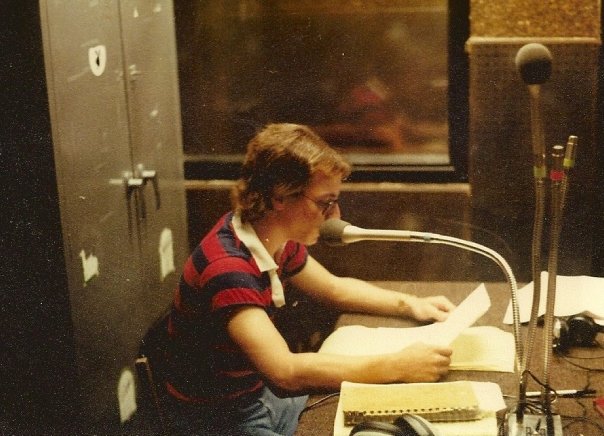

I grew up in a different era. I am a dinosaur. At least when it comes to radio.
I went to college at the University of Miami with a clear intent on embarking on a career in broadcasting, and although I dabbled on the TV side of things, radio seemed to be my comfort zone. I loved being on the air, behind that microphone. I did newscasts and a number of jock shifts in my day, but my passion was always for sports.
The great thing about the University of Miami campus radio station was that you could join the staff of any department as soon as you arrived on campus. Freshmen were welcomed…unlike other top Communication schools where only upperclassmen are permitted to partake in the activities.
I dove in and spent the majority of my time at WVUM, Coral Gables (the proper station ID). I also was able to hone my craft at other outlets such as WVCG, WYOR, WNWS, WCTC, Associated Press (AP) radio, United Press International (UPI) radio, NBC radio network, and even wrote under my pseudonym (Joe Lisi) for The Miami Herald.
But since then, and over the years, the medium of “terrestrial radio”…the transmission of airwaves over land-based towers to radio receivers, primarily using AM and FM frequencies, has lost its cache. Satellite radio and internet/streaming services have really taken over the majority of the market share. The reason? Why be saddled with limited choices and formats when I can get to hear anything I want at any time? Although…terrestrial radio still serves an important purpose. But with the other options out there, it’s hard to make an argument for an entity to spend money on advertising for “over the air” radio when the listeners are going elsewhere and are paying a subscription for what they really want.
Hence…the shutting down of CBS New Radio. The news network has been around for almost 100 years and was well-known for its iconic top-of-the-hour updates and its news feeds provided to hundreds of affiliate stations. It will officially sign off on May 22, 2026, due directly to declining revenues and the aforementioned shifting listening habits.
The changes are trickling down, and it’s become apparent that the interest in radio is not close to what it used to be, and really not even recognizable. It’s become apparent on the college radio scene. What I experienced 40 years ago is absolutely nothing like what exists today. Even as college students, that campus radio station was like a religious alter, a place that was revered, that was respected, that was appreciated. We worked like we working at a job where we were trying to carve out a niche for ourselves, learning the skills, and gaining valuable experience to catapult us into a career. At least most of us operated that way.
Today, if the campus radio station even remains in existence, it is a place to assemble for social gatherings and it has become nothing more than a club for the people that are in need of a hobby, and a part-time gig if nothing more important is happening elsewhere. While we prided ourselves on being able to say that we were on the air, with a human at the board, at the mic, 24 hours a day, 7 days a week, 52 weeks a year, today’s stations are mostly automated the majority of the time.
I looked at three of the most well-known Communications schools in the country – University of Miami, Syracuse University, and Northwestern University. All three have a strong history and an outstanding reputation for producing some of the top and most well-known radio broadcasters (and TV) in the industry. And guess what? None of the three have a radio broadcasting curriculum. None of the three offer a course in radio performance or radio production or broadcast management.
None of these three top Communications, Broadcasting, schools offer anything that will draw a student into the field of radio. And so it’s no surprise at all that there would be no students AT those schools who would be trekking to the campus station with the idea of using the experience to embark on a career in radio.
But, then, why would they? The medium of radio, as we knew it, is no longer in existence.
Here are some thoughts of friends (of my generation) and former colleagues, on how radio has changed over the years and how it is perceived today.
Dave LaMont: It sucks now. You’re welcome.
Chris Stonick: It’s been my income my entire life. I am still a fan.
George Burbank: Radio used to be a key source for receiving important information. Before our time, folks would gather around the radio to be both informed and entertained. Even when we were growing up, many local sporting events were not televised, but were broadcast on the radio. Well, that changed when folks realized how much money could be made from television, and radio took a backseat. Everything changed when radio became interactive on a widespread scale, and we viewed radio as a conduit for our vices and opinions to be heard. Sports talk radio, for one, challenged us to have an opinion every day. Funny how our teams are seen so differently after only a single game. Nowadays, radio is a distraction or non-visual information source while driving.
Lisa Shabsis Kay: I was a change of life baby…my parent were born in 1921. Radio for them was their main source of entertainment and receiving important information. My parents told me how the entire family would sit in a living room listening to either the news, war updates, or their favorite shows. When I was born in the 60’s, television was new, but I remember that but I remember that being the main source of information and entertainment. I loved radio for music. I had a portable radio that I brought with me almost all the time. Today, I still listen to the radio, but it’s mostly when I am driving.
David Auslander: When I started driving in 1977, I ALWAYS listened to local FM, first on Long Island, and then Miami, where I’ve been since ’79. Over the past decade, I ONLY listen to AM for news and sports – all music is Sirius XM. I can’t even tell you what the local FM stations are. At home, the only exception is WDNA, Public Radio, since I enjoy jazz and blues on in the background when I am on the computer.
David Dweck: When I was a young kid in New York, I started listening to ’77 WABC. Aside from the greatest pop/roack era of the mid to late ‘60’s to the mid to late 70’s, the great personalities were also a part of it – Cousin Brucie, Dan Ingram, Roby Yonge, Scott Muni, Allison Steele, etc. Today, terrestrial radio sucks, the music is mediocre, BUT you can get turned on to lots of music through satellite radio or streaming. I miss the old days of a good talk show, the AM talk radio. Just my two cents.
Otto Busher: Unfortunately, I hear in New Hampshire that radio is an obsolete medium. Listening audiences are over 50 years old and shrinking every passing day. I like radio, perhaps I am just not keeping up with current trends.
Steve Goto: Succumbing to someone’s music format mixed with commercials is frustrating. The iPod changed my world. Now AI knows what you like. I only listen to local radio when I have to. I listen to SXM, but music is only good during drive times. B-side crap in off hours. Good personalities make for good radio by injecting a human being in between formatted stuff, but even Howard Stern is slipping. Entertaining conversation is being replaced by podcast.
Mike Makransky: It wasn’t “video killed the radio star…”, it was smart phones. I remember people hiding transistor radios at work to listen to the Mets in their first World Series. Always thought it would be fun to be the color guy working with the humorless play-by-play expert.
Dennis Turner: Radio still plays a very important role in my life, especially the best “all news” stations. WINZ, back in the day, and later, KNX, and more recently, KRLD, became very important to me, and let me to nine years as a freelance correspondent for CBS News Radio. I still roam the dial at night sometimes looking for far-away stations to listen to. NPR was important to me for a long time. I met and later worked in the shadow of Rush Limbaugh and Laura Schlesinger who kept AM radio relevant. But it’s really the all news stations that I believe are keeping radio relevant to the extent that it still is. Good journalism is also keeping broadcasting in general relevant, especially in hard to reach or underserved areas. As for the future, people will always love a good story, no matter how it’s delivered.
Mike Weinstein: Radio is clearly generational. And as our age group, and older age groups, go away, so does the general audience. My Gen Z kids don’t listen, too many other streaming and alternate ways to hear music. News is available in so many other places, and traffic reporters like me will be dinosaurs soon as dashboard and smartphone apps provide personalized traffic that many don’t receive on the radio. I am saddened as this medium disappears but we should all be ready for the day it finally goes away.
Well…the medium has changed immensely. It has pretty much disappeared from college curriculums, and the interest has been lost on the college campuses. But the demise of one of the most prominent and respected news radio outlets clearly indicates that, for better or worse, the medium of terrestrial radio is dying a slow death. Definitely for the worse.